Fertility testing: what a full workup includes
A fertility workup looks at both partners at once: her ovulation hormones, ovarian reserve, uterus and ovaries, and his semen. ASRM advises starting both evaluations together because a male factor is so often involved. Gala Fertility runs the whole workup for couples, with labs near you, a semen kit at home and one clinician reading every result. You start with a $29.99 introductory video meeting.
For male-female couples, both partners 18 or older.

What infertility testing includes
A complete evaluation answers four questions: is she ovulating, how much ovarian reserve is there, are the uterus and tubes open for a pregnancy, and what does his semen look like. Here is how each piece is covered in Gala Fertility.
| What is checked | The tests | Where |
|---|---|---|
| Ovarian reserve | AMH, plus FSH and estradiol early in her cycle | Walk-in Quest lab, day 2 to 5 of her period |
| Hormones behind ovulation | LH, prolactin and TSH (thyroid) | Same blood draw |
| Uterus and ovaries | Transvaginal pelvic ultrasound with a follicle count | Imaging center near you, booked for her |
| Preconception health | HIV, hepatitis B and C, syphilis, chlamydia and gonorrhea; immunity to measles, rubella and chickenpox | Same blood draw, plus a urine sample |
| Sperm | Semen analysis: volume, pH, concentration, motility and morphology | Kit shipped to his home and mailed back |
| His hormones | FSH, LH, TSH, total and free testosterone, SHBG | Quest lab, if your clinician indicates it |
| Fallopian tubes | Hysterosalpingogram (HSG) or a saline sonohysterogram | A fertility clinic, after a referral if your history calls for it |
The last row is worth knowing before you start. A pelvic ultrasound shows the uterus and ovaries but not whether the tubes are open. NIH lists an X-ray hysterosalpingogram or laparoscopy for that, and both are clinic procedures. If your history points to a tubal problem, your clinician refers you and tells you why.
In what order, and how long it takes
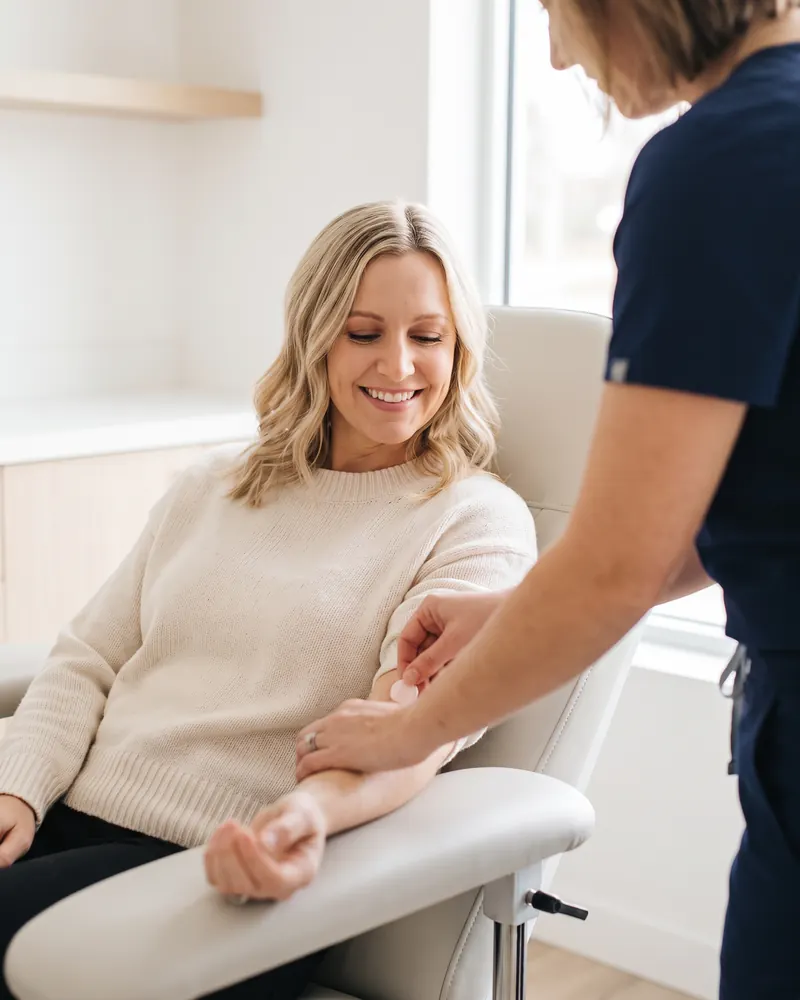
You both answer one intake first. Her blood draw then waits for the start of her next period: ASRM's committee opinion says FSH and estradiol should be measured together in the early follicular phase, while AMH can be measured at any point in the cycle. Gala Fertility draws everything on day 2 to 5 of her period so one visit covers it all.
His kit ships to your home in parallel, and the imaging team contacts her to book the ultrasound once a clinician has reviewed your intake. So the honest answer to how long infertility testing takes is: mostly as long as it takes for her next period to arrive.
How the results are read
One clinician reviews both histories and every result together, because a borderline semen analysis means something different next to a normal workup for her than next to irregular cycles. Results show in your portal once they have been reviewed, and one video visit with both of you covers what they mean and what comes next.
- AMH and the follicle count estimate how many eggs remain. ASRM says ovarian reserve markers predict egg yield in IVF but are poor predictors of the chance of pregnancy independently of age, so a low number is a reason to talk, not a verdict.
- A single semen analysis can mislead: NIH notes that sperm production varies with health, activity and stress, so a borderline result is often repeated.
- If she is not immune to measles, rubella or chickenpox, ASRM advises vaccinating before pregnancy and avoiding pregnancy for 4 weeks afterward. In Gala Fertility that vaccine is arranged through your primary care provider.
- An infection found on screening is treated before any fertility treatment starts.
When to get tested
ASRM advises an evaluation after 12 months of trying when the woman is under 35 and after 6 months at 35 or older, and sooner if she is over 40 or either of you has a known reason to suspect a problem. The details are in how long to try before testing.
What it costs
Labs list single tests at roughly $80 to $300 each without insurance, before any consult or ultrasound; the line-by-line prices are in how much fertility testing costs. With Gala Fertility you start with a $29.99 introductory video meeting, credited to your first cycle if you go ahead. After that, your plan is one all-inclusive price per cycle, shown before you commit: medication if prescribed, a check-in after every cycle, your video visits, messages with your care team and all program tests for both of you.
Questions, answered
What does infertility testing include?
For her: hormone bloodwork (AMH, FSH, estradiol, LH, prolactin, TSH), preconception screening and a pelvic ultrasound. For him: a semen analysis, plus hormone bloodwork when indicated. Tubal testing, such as an HSG, is done at a fertility clinic after a referral.
How long does infertility testing take?
Mostly as long as it takes for her next period: her bloodwork is drawn on day 2 to 5 of her cycle. His semen kit and her ultrasound are arranged in parallel, and results appear in your portal once a clinician has reviewed them.
Do both partners need fertility testing?
Yes. ASRM says that when a male partner is contributing to the pregnancy, evaluation of both partners should begin at the same time, with at least one semen analysis at the start.
How much does fertility testing cost with Gala?
You start with a $29.99 introductory video meeting with the care team. If you both agree to start a plan, the $29.99 is credited to your first cycle and testing for both of you is included, with no extra cost for tests.
What happens if one of our results is abnormal?
Your clinician explains it on your video visit and tells you the next step: repeating a test, treating an infection first, a vaccine through your primary care provider, or a referral to a fertility clinic or reproductive urologist.
Can fertility testing check whether my tubes are open?
Not with a standard pelvic ultrasound. Tubal patency needs a hysterosalpingogram, a saline sonohysterogram or laparoscopy, done at a fertility clinic. Your clinician refers you if your history calls for it.
A $29.99 first step
Book an introductory video meeting with our care team. If you both agree to start, your plan begins and the $29.99 is credited to your first cycle. After that, your plan is one all-inclusive price per cycle, shown before you commit: medication if prescribed, a check-in after every cycle, your video visits, messages with your care team and all program tests for both of you. See what the program includes.
Sources
- Practice Committee of ASRM. Fertility evaluation of infertile women: a committee opinion. Fertil Steril. 2021.
- Practice Committee of ASRM. Testing and interpreting measures of ovarian reserve: a committee opinion. Fertil Steril. 2020.
- NICHD, NIH. How is infertility diagnosed?
- Practice Committee of ASRM. Definition of infertility: a committee opinion. 2023.
- Practice Committee of ASRM. Current recommendations for vaccines for patients planning pregnancy: a committee opinion. 2024.
General information, not medical advice. Your clinician interprets your own results.